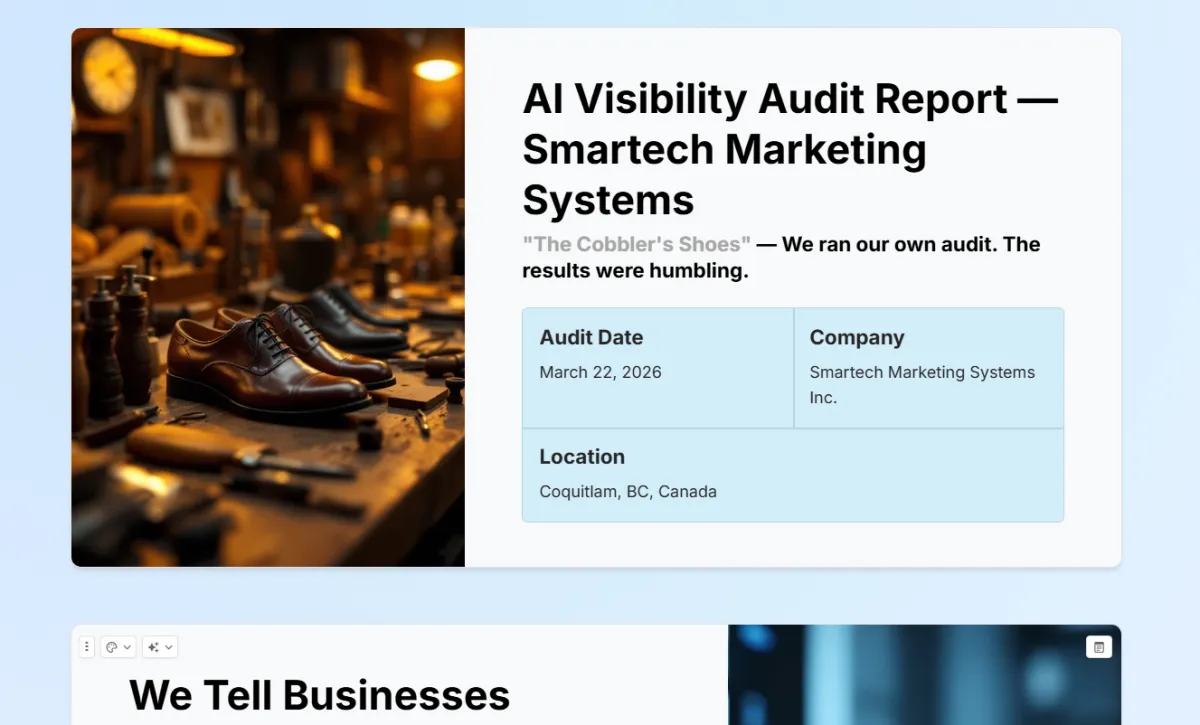
I've Been Testing Local Businesses Across 5 AI Platforms. Most of Them Are Completely Invisible
Over the past few months, I've been running AI visibility audits for local businesses across Australia, the US, and Canada. The concept is simple: I type the same questions their customers would type — "best physiotherapist near me," "who should I do my taxes with in Sydney," "reliable builder in Melbourne" — into ChatGPT, Gemini, Perplexity, Claude, and Google's AI Overview. Then I see who gets recommended.
The results have been eye-opening. Not for me — I expected this. But for the business owners getting the reports back.
The headline finding: 6 out of 10 businesses I audited had 0% visibility on at least one major AI platform. Not low visibility. Zero. As in, the AI had no idea they existed.
These aren't bad businesses. Most of them have solid Google rankings, decent reviews, and years of reputation behind them. But when a potential customer asks AI who to hire, they're nowhere.
Why? Because AI doesn't read your website the way Google does.
Google crawls your site, indexes your pages, and ranks them based on keywords, backlinks, and authority signals. AI does something different. It looks for structured data it can parse — schema markup, FAQ sections written in natural language, consistent business information across the web, and reviews it can cross-reference.
Most local business websites weren't built with any of that in mind. They were built to look good and rank on Google. And that worked — until people started skipping Google entirely and asking ChatGPT instead.
Here's what I've seen across these audits:
Businesses with strong review profiles (50+ Google reviews, 4.5+ stars) tend to get mentioned more often by AI. But reviews alone aren't enough. I've audited businesses with hundreds of five-star reviews that still scored under 20% because their website gave AI nothing to work with — no schema markup, no FAQ content, no structured service descriptions.
On the flip side, I've seen competitors with half the reviews and a fraction of the reputation show up consistently across all five platforms — simply because their online presence is structured in a way AI can actually read and cite.
The gap isn't about quality. It's about readability.
The fix isn't complicated, but it does require knowing what to look for.
The most common issues I find are: missing schema markup (the structured code that tells AI what your business is, where you're located, and what services you offer), no FAQ sections (AI loves FAQ content because it mirrors how people ask questions), blocked AI crawlers in robots.txt (some businesses are literally telling ChatGPT's crawler to go away without realizing it), and thin or generic website content that doesn't give AI enough to distinguish you from competitors.
Most of these can be addressed in 30 to 60 days. Schema markup alone can shift how AI categorizes your business within weeks. Adding FAQ content that matches real customer queries gives AI something specific to cite. And unlocking AI crawlers is a five-minute fix that some businesses don't even know they need.
The uncomfortable truth is that this is a compounding problem.
The businesses showing up in AI recommendations right now are accumulating more visibility, more customers, and more reviews — which feeds even more AI recommendations. It's a flywheel. And every month you're not in it, the gap between you and the businesses that are gets wider.
I don't say that to create panic. I say it because I've watched it happen across three countries and a dozen industries. The businesses that move now will be very difficult to catch later.
If you're curious where your business stands, I run free audits. No pitch, no obligation. I test your business across all five AI platforms and send you the results. You'll know in 48 hours exactly where you show up, where you don't, and who's being recommended instead of you.
You can request one here: smartechsystems.com/ai-audit
Or just reply if you're reading this on LinkedIn — I'll run it manually and send you the report.
— Chris Small Founder, Smartech Marketing Systems