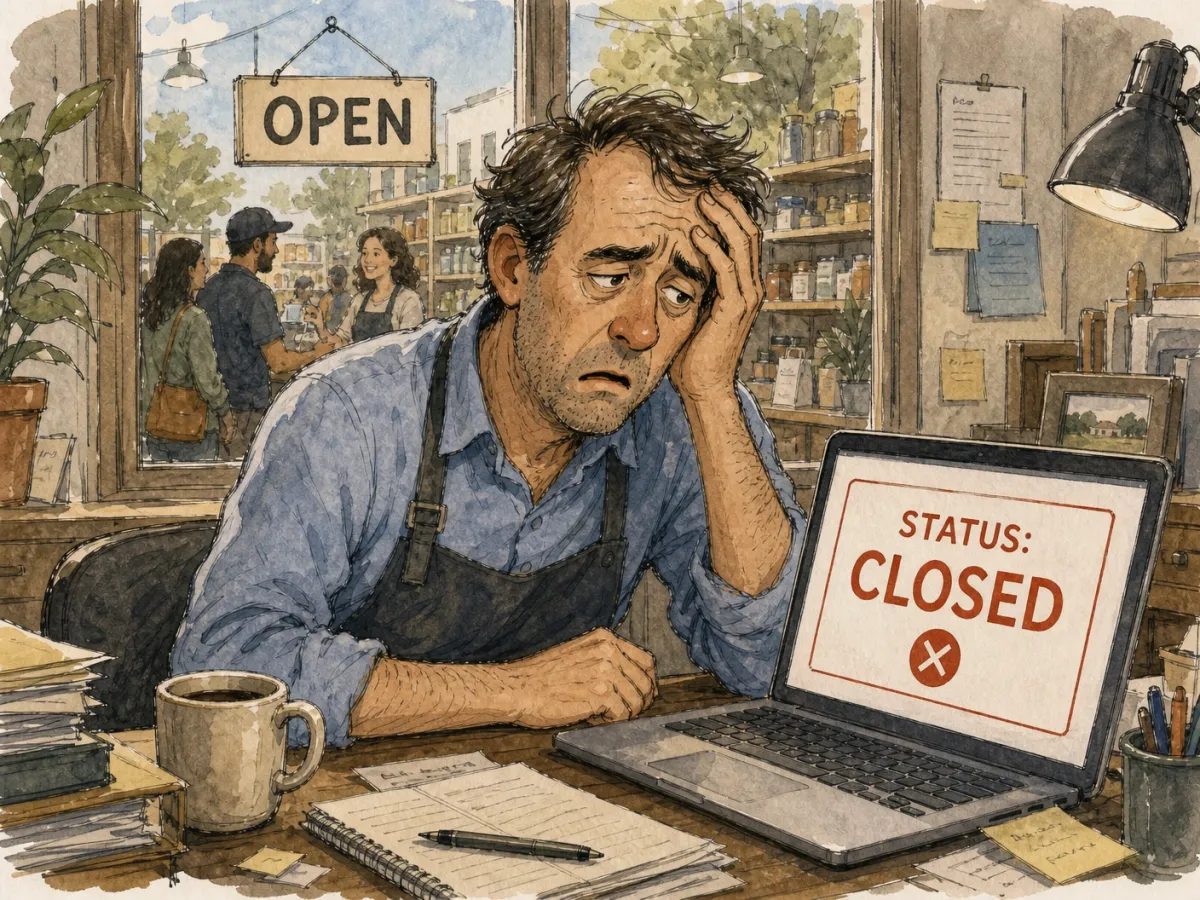
AI Said Their Business Was CLOSED. It Wasn't.
A plastic surgery practice in Australia.
Active. Busy. Surgeries booked through the month. Their Google Business Profile fully operational, with five-star reviews, current photos, the right phone number.
Then I ran an AI visibility audit on them.
The AI tool reported, with full confidence: "Status: Closed."
It wasn't. Not even a little bit. The practice was open and taking patients while an AI tool was confidently telling anyone who asked that they were shut down.
Now imagine a GP somewhere looking for a specialist to refer a patient to. They ask their AI assistant about that practice. The AI tells them it's closed.
The patient gets referred somewhere else. The practice never sees the referral that didn't happen. Nobody calls them to ask. They just notice, three months later, that their referrals are down. They'll never know why.
That's the first cost of AI hallucination. You'll never see it on a report.
And it wasn't a one-off
In the same month, working on real audits for paying clients, I caught four more.
A financial advisor's "affiliation." An AI tool reported the firm was affiliated with one of the major broker-dealers. It wasn't. The AI had pulled "advisor in this town" + "common firm name in financial services" and confidently generated an affiliation that doesn't exist. Depending on jurisdiction, that's not just embarrassing. It can cross into regulatory territory.
A competitor that doesn't exist. A wholesale supplier's competitive analysis included five competitors. Four checked out. The fifth was a plausible-sounding industry compound word with zero presence on the public web. If the business had built positioning around that competitor, they'd have been benchmarking against a ghost.
A review count off by half. A business with 67 Google reviews was reported as having 24. Not "approximately 24." Just 24. Confident as anything.
A research citation that didn't exist. I asked an AI research agent to find me a source. It returned a confident citation with a URL. The URL didn't exist. The article didn't exist. The publication was real but had never published the piece in question.
That last one is worth sitting with for a second. Imagine your accountant doing it. Your lawyer. Your kid's school. Anyone using AI as a research shortcut and not clicking through.
Why AI does this
AI has a problem. It can't say "I don't know."
Not really. Not in any meaningful way. It's been trained, hard, on the idea that being useful means answering. An AI that responds to your question with "I don't know" feels broken to the people who built it. So it doesn't say that. It says something.
When it actually doesn't know, it doesn't admit it. It generates the most statistically likely answer-shaped response, the words that look right based on patterns in everything it's been trained on. Sometimes that lines up with reality. Sometimes it doesn't. Either way, it sounds exactly the same.
The fluency is the danger. Bad information delivered hesitantly triggers your skepticism. Bad information delivered fluently slides past your guard.
And if you're thinking "well, I don't use AI in my business so this doesn't apply to me" — AI is already in your business, whether you put it there or not. The customer who used Siri to find your hours. The journalist asking ChatGPT for a source. The Google AI Overview that summarized your business before showing the link. The customer drafting a review response with help from Gemini. The version of your business those tools are presenting might be accurate. Or it might be one of these examples.
You don't know until you check.
How to catch it
Three things you can do today. No special tools required.
Run the test on your own business. Ask ChatGPT, Gemini, and Perplexity about your business by name. Read what they say. Check every specific claim, every number, every affiliation. Note what they got wrong. That's the version of your business potential customers are seeing.
Ask the AI to cite its sources. Perplexity does this by default. Every claim links to where it came from. Other AIs will too if you push them: "Cite your sources for each fact you stated." Then click the links. If the link doesn't exist, neither does the fact.
Prompt for uncertainty. AI defaults to confident. Push back. "Are you certain about that?" Or: "What's your confidence level on each claim?" Or the one that works best: "What would make you wrong about this?" These force the AI to surface its weak points instead of glossing over them.
Bonus: run important AI output through a second AI. If the two disagree, you've found the soft spot worth checking.
What this means
AI doesn't lie because it's malicious. It "lies" because it's been trained to never leave you without an answer, and it can't always tell the difference between an answer and a guess.
You can.
The AI confidence problem doesn't go away because the AI gets better. It goes away when you build the habit of treating AI confidence as a signal to verify, not as proof.
That's the actual job. Whether someone else does it for you, or you do it yourself.