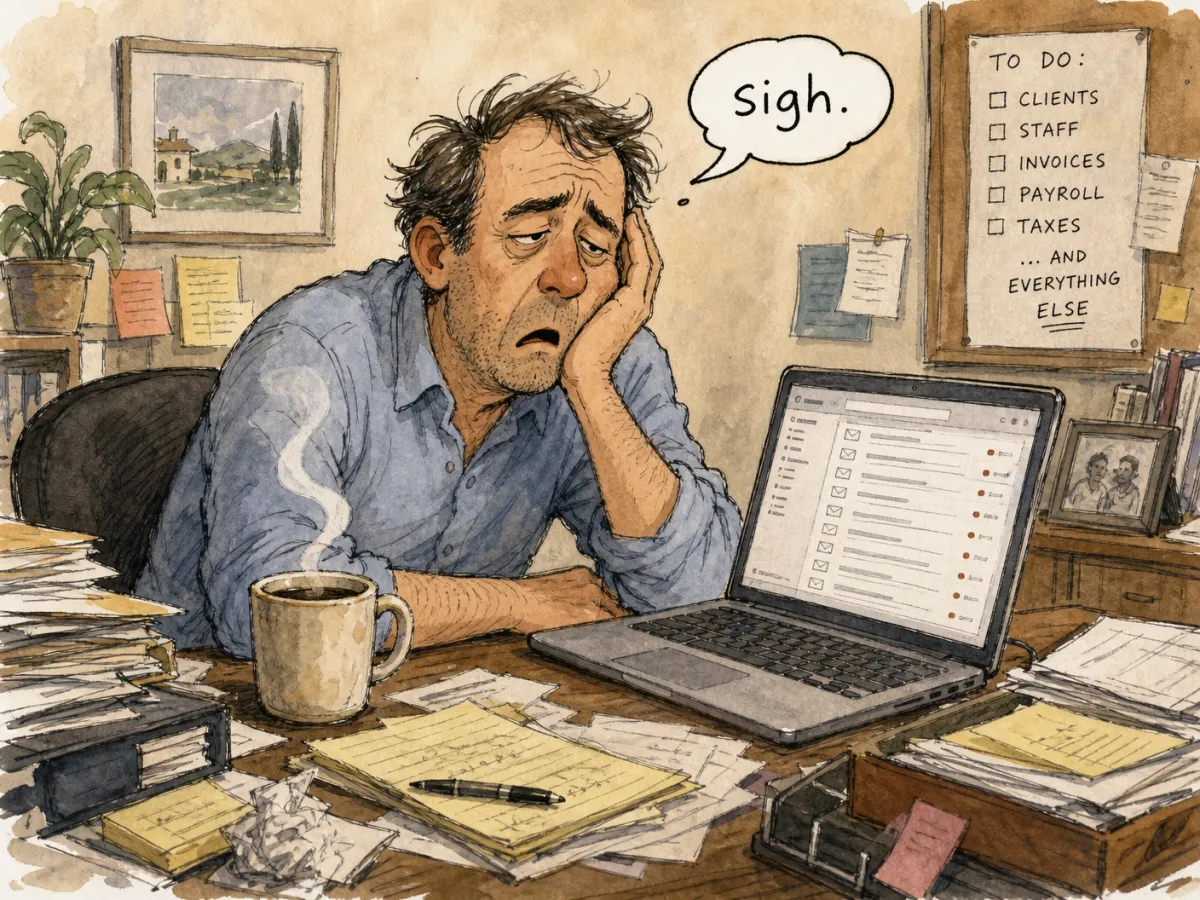
41 Days, 8 Emails, and One Google Listing That Almost Died
"Can you check if this email is actually from Google? I'm starting to think it might be a hacker."
That's me. Forty-one days and eight emails into a Google support case, asking my AI assistant whether the reply I'd just received from "Google support" was even real.
It was. The replies had just gotten that strange.
The setup
I'll keep the client anonymous. Doesn't matter who they are. Australian small business owner with a perfectly normal need: clean up a duplicate Google Business Profile listing so the right phone number showed up when customers searched for them.
That was the whole job.
And it wasn't cosmetic. AI tools like ChatGPT, Gemini, Perplexity, and Google's own AI Overview only surface businesses they can verify across the web. Same name, same address, same phone, everywhere. Two listings break that match. The AI sees two versions of the business, can't tell which is real, and quietly recommends the competitor next door instead.
Two listings existed for this business. One was the original, public-facing one, flagged by Google as a duplicate. The other had been created later. Both needed to be reconciled.
You might assume there's a clean process for this. Submit a form, prove ownership, problem solved.
That's what I assumed too.
I was wrong.
What "support" actually looks like
The first support reply came in and I almost cheered. Plenty of Google cases die in silence and I was braced for that.
Then I read it.
The advice walked me through a workflow that required admin access I didn't have. The next reply contradicted the previous one. The one after that recommended an action that, per Google's own help docs (which I checked), wouldn't accomplish anything close to what we were trying to do. By email three or four, I started wondering if anyone on the support side was actually reading my emails or just feeding them into a decision tree.
Then came the dangerous one.
The agent advised an action that, if I'd followed it, would have wiped the listing entirely. There's no undo button on that. Once a verified profile is gone, you're starting from scratch, and a competitor with a faster trigger finger can claim the position you just vacated.
I started forwarding the emails to my AI assistant just to help decode them. The two of us would sit there debating what the human on the other end (if it was a human) was actually trying to say. There were sentences we both gave up on.
Wait — is this even real?
By email six or seven, I had to stop and ask myself whether I was being phished. The tone was off. The grammar was inconsistent. Advice from this case contradicting advice from the same case two emails earlier.
That's when I asked my AI to verify the email headers. Was this actually from Google, or had someone hijacked the case ID?
It was Google. Probably either a poorly trained AI on the back end, or a non-English speaking agent using AI to translate.
So I was very likely an AI visibility consultant, arguing with AI, about why a business wasn't visible to AI. Through emails I was forwarding to my own AI to decode. Six weeks of this.
Either way, the result was the same. I couldn't take the advice at face value. Every recommendation had to be checked against actual Google policy documents before I could act on it.
Which, if you think about it, defeats the entire purpose of having support.
The small win
After weeks of going in circles, I finally confirmed something the support team had repeatedly failed to: I was the Primary Owner of the public-facing listing. Top-level access. The same access the support team had spent multiple emails suggesting I might not actually have.
Confirming that didn't fix the duplicate problem. Only Google can merge two listings, and they still haven't. But owner-level access meant I could stop the bleeding without them.
So I went around support entirely. Submitted the phone number correction from the owner account through the public "Suggest an edit" path. Twenty-four hours later, the correct number was showing on Google Search.
That sounds like a small win. It isn't. For 41 days, customers searching for this business saw the wrong phone number. Anyone who called reached a dead end. How many leads we lost in that window, nobody will ever know.
The part that's still broken
And the case still isn't closed.
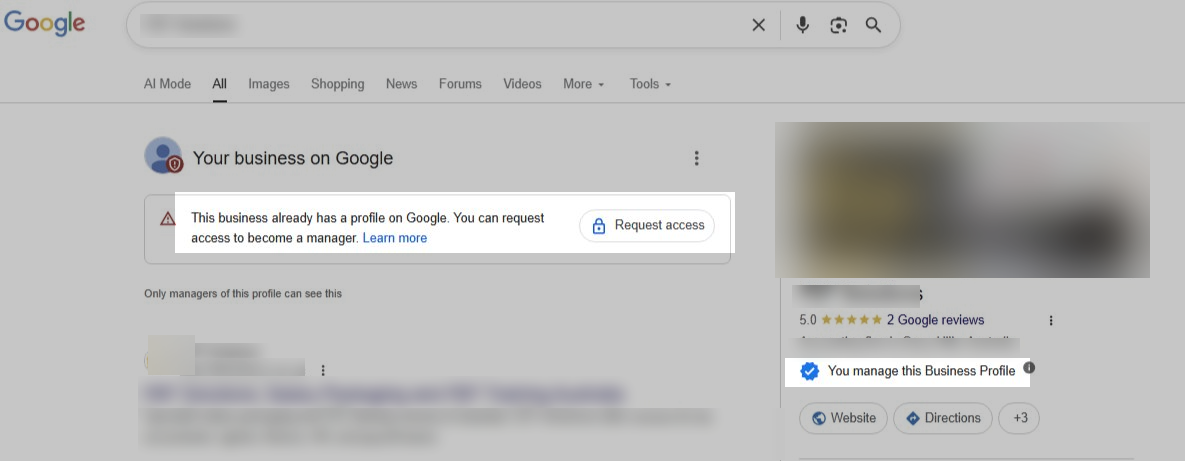
The merge problem persists. And as I write this, Google Business Profile Manager shows two contradictory states for the same listing on the same screen. One panel: "Request access to become a manager." Implying I don't have access. The other: "You manage this Business Profile." Plain and clear.
Same account, same listing, two answers, depending on which Google interface you happen to be looking at. The only way to know what's actually true is to try an action and see if it works.
Most business owners, faced with this kind of fight, give up. I get it. On most days you can't justify it. There are customers to serve and a hundred other fires to put out.
But the listing doesn't politely vanish along with your patience. It stays right where it is, with the wrong information, while a competitor with a working listing eats your lunch.
Forty-one days. Eight emails. One phone number.
I'd do it again tomorrow. Because the alternative isn't "leaving things as they are." It's a business that quietly disappears from search while everyone wonders why the phone stopped ringing.